Electromagnetic Induction
Introduction
We have learnt that varying electric field can induce a magnetic field, the converse of this phenomenon is electromagnetic induction. The is because, the changing magnetic field produces an electric field which curls around it, this electric field exerts a force on the charges present in the conductor and does work on them. Thus a time varying magnetic field produces an electromotive force which pushes the charges, thus, generating an electric current.
Also, we know the fact that magnetic field never does any work on moving charges as the magnetic force is always perpendicular to the direction of their motion. Since the conservation of energy holds true for this case, the electrical energy in electromagnetic induction does not come out of thin air, the electrical energy of the induced current comes from the mechanical work done in overcoming the opposing magnetic field produced by the induced current.
Faraday's Law
Faraday was the first person to discover and experiment electromagnetic induction. His experiment goes as follows:
Experiment:
Consider a conducting loop connected to a galvanometer, the loop is not connected to a battery or any emf source, hence, there is no current flowing in the conducting loop.
A bar magnet is brought and placed near the conducting loop, there is no visible change observed in the setup. Now, the bar magnet is moved rapidly to and fro from the conducting loop with the axis of the magnet facing the loop, we can observe the deflection in the galvanometer, this deflection stops as soon as we stop moving the magnet.
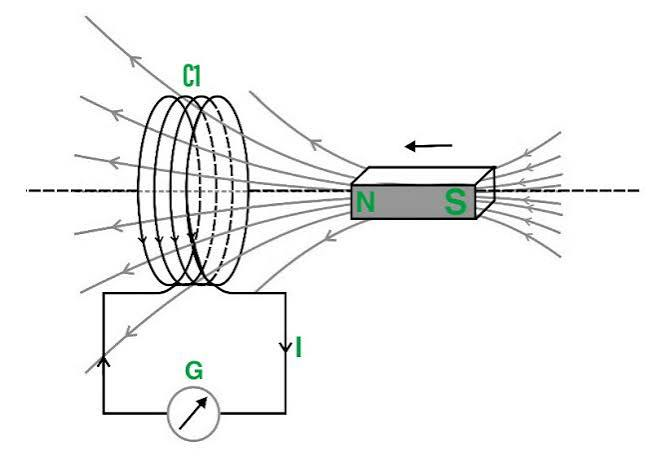
These observations from this experiment:
- The current only when there is a relative motion between the magnet and the conductor.
- The magnitude of the current is directly proportional to the velocity at with the magnet is moving w.r.t to the conductor.
- This induced current is produced by the time rate of change of the magnetic flux through the coil.
Note: He also did another experiment in which two coils one carrying a current an another with no current moved relatively together induced a current in the coil with no current.
From his numerous experiments he finally arrived at his low of electromagnetic induction:
Faraday's Law of electromagnetic Induction:
Whenever the flux through the area bounded by a closed conducting loop changes, an emf is produced in the loop.
Mathematically this law is given by:
where
Note: Here, the "-" sign is present because the EMF produced is such that it always opposes the cause that changes the magnetic flux so that energy remains conserved.
Lenz's Law & Direction of Induced Current:
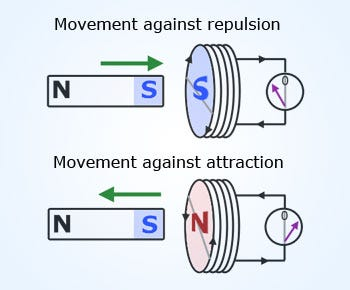
We have discussed that the emf produced is such that it always opposes the cause that produces it,
One of the observations in Faraday's experiments is that if moving the magnet’s north pole toward the loop causes, say, clockwise current, then moving the north pole away causes counterclockwise current. Moving the south pole toward or away from the loop also causes currents, but in the reversed directions.
The explanation to this was given by Lenz's law and it goes as follows:
The direction of induced EMF or induced current in a conductor or coil due to electromagnetic induction is such that the effescts produced by the induced EMF or current, opposes ths cause that produces it.
Possible scenarios:
- Moving the north pole of a bar magnet towards the coil induces an anticlockwise current i.e a north pole magnetic field in face of the coil that faces the magnet (in order to oppose/repel the movement of the magnet i.e change of flux).
- Similarly moving the north pole away form the magnet induces a clockwise current (south pole facing the magnet) in order to oppose its motion (attract it back).
- The effects are similar for the south pole also.